
Have you ever looked at an old photograph of yourself and wondered where the years went? It’s a question every generation has asked in one form or another. We notice new wrinkles, slower recovery after exercise, or the need for reading glasses, and we naturally ask: Why does this happen?
For much of human history, aging was viewed as an unavoidable consequence of simply getting older. Today, scientists see it differently. Rather than being caused by a single “aging switch,” growing older appears to be the result of countless biological processes that slowly change over time.
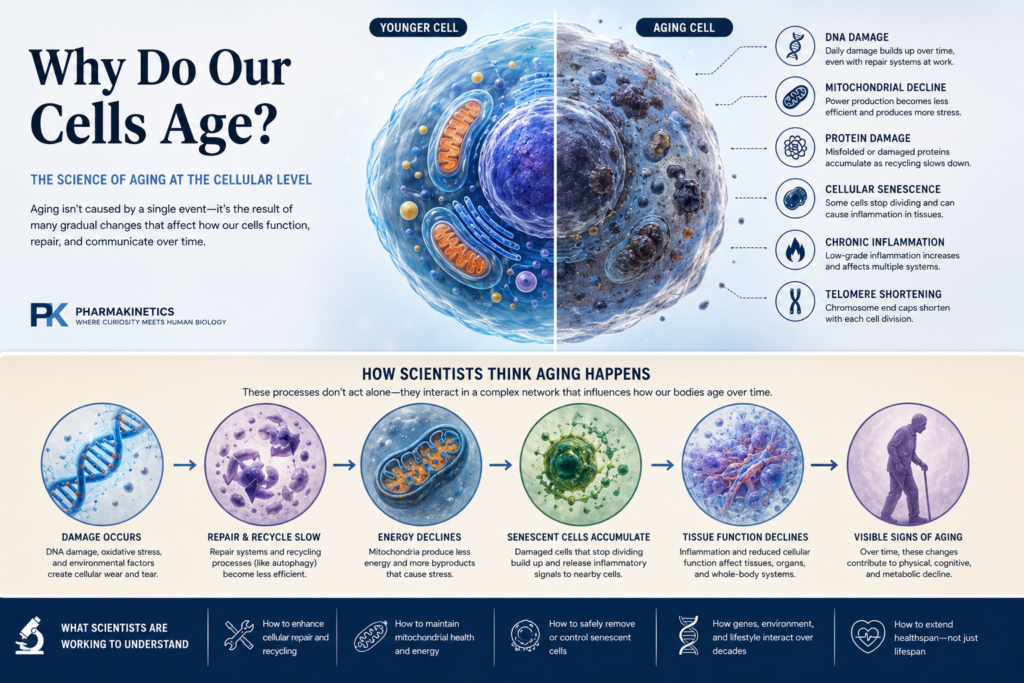
Perhaps the most surprising discovery is that your body doesn’t stop trying to stay young. Quite the opposite. Every second of every day, trillions of cells are repairing DNA, recycling damaged proteins, producing energy, replacing worn-out components, and communicating with neighboring cells. Aging occurs not because these systems suddenly stop working, but because, over decades, they become less efficient.
Understanding why this happens has become one of the fastest-growing fields in modern biology. While there is still much to learn, researchers have uncovered remarkable insights into how our cells change with age and why some people appear to age differently than others.
Your Body Is Constantly Rebuilding Itself
It’s easy to imagine the human body as something static, but nothing could be further from the truth.
Your skin continuously replaces itself. Blood cells are constantly being produced in your bone marrow. Cells lining your digestive tract are renewed every few days. Even inside individual cells, proteins are constantly broken down and rebuilt.
Think of your body less like a machine and more like a city under perpetual construction. Roads are repaired, buildings are renovated, waste is removed, and new materials arrive every day. As long as maintenance keeps pace with wear, the city functions smoothly.
Your body works in much the same way.
Throughout life, specialized repair systems monitor DNA for errors, remove damaged proteins, recycle worn-out cellular components, and coordinate immune responses. These maintenance crews are extraordinarily effective—but like any complex system, they gradually become less efficient over time.
Aging Isn’t Caused by Just One Thing
One of the biggest misconceptions about aging is that it has a single cause.
In reality, aging is more like a symphony with many instruments playing at once. Scientists have identified numerous biological processes that interact throughout life, influencing how tissues function and respond to stress.
Rather than working independently, these systems affect one another. Changes in one area can ripple throughout the body, influencing metabolism, immune function, cardiovascular health, cognitive performance, and tissue repair.
Because these processes are interconnected, aging is better understood as a network rather than a single event.
DNA: Protecting the Body’s Instruction Manual
Every cell contains DNA—the genetic blueprint that provides instructions for building and maintaining life.
Each day, normal metabolism, ultraviolet light, environmental exposures, and simple errors during cell division create thousands of tiny injuries to DNA. Fortunately, cells are equipped with sophisticated repair systems that identify and correct much of this damage before it becomes a problem.
For decades, these repair mechanisms perform remarkably well.
Over time, however, some damage escapes repair. Small changes accumulate, and while many have little effect, others may alter how cells function.
It’s important to understand that DNA damage alone doesn’t explain aging. Instead, it represents one piece of a much larger biological puzzle.
The Cell’s Power Plants Begin to Lose Efficiency
Inside nearly every cell are structures called mitochondria.
They’re often described as the “powerhouses” of the cell because they convert nutrients and oxygen into ATP, the molecule that powers nearly every biological process.
Mitochondria are remarkably efficient, but they also work continuously. Every heartbeat, every breath, every thought, and every muscle contraction depends on them.
As researchers have studied aging, they’ve found that mitochondria may gradually become less efficient in some tissues. Energy production can decline, while byproducts of metabolism—including reactive oxygen species—may increase.
Scientists now believe mitochondrial health plays an important role in how cells respond to stress and maintain normal function throughout life.
When Cells Decide It’s Time to Stop Dividing
Not every cell continues dividing forever.
Some eventually enter a state known as cellular senescence.
Senescent cells remain alive but stop dividing. Initially, this appears to be a protective mechanism. Preventing damaged cells from multiplying may reduce the risk of certain diseases, including cancer.
The challenge comes when senescent cells begin to accumulate.
These cells can release signaling molecules that influence nearby tissues and contribute to chronic, low-grade inflammation. Researchers continue investigating how much this accumulation contributes to age-related changes and whether removing certain senescent cells could one day support healthier aging.
It’s an exciting area of research, but many important questions remain unanswered.
The Body’s Recycling System Slows Down
Your cells are surprisingly tidy.
When proteins become damaged or cellular components wear out, specialized recycling systems break them down and reuse many of their building blocks.
One of these processes is known as autophagy, which literally means “self-eating.”
Despite the dramatic name, autophagy is an essential housekeeping system that helps maintain cellular quality by removing damaged components before they accumulate.
Researchers have observed that this recycling process may become less efficient with age, allowing damaged proteins and organelles to persist longer than they should.
Maintaining healthy cellular housekeeping remains an active area of longevity research.
Why Do Some People Seem to Age More Slowly?
This is perhaps one of the most fascinating questions in modern science.
If aging is driven by biology, why do some people remain active, cognitively sharp, and physically resilient well into later life?
The answer appears to involve a combination of genetics, environment, lifestyle, and chance.
Some individuals inherit genetic variants associated with exceptional longevity. Others may benefit from lifelong habits that support cardiovascular health, metabolic function, sleep, and physical activity.
Researchers increasingly believe healthy aging isn’t determined by one factor but by the cumulative effects of thousands of small influences acting over many decades.
Rather than searching for a single “longevity gene,” scientists now study how multiple biological systems interact throughout life.
Lifespan Versus Healthspan
Living longer and living better are not always the same thing.
Longevity researchers increasingly focus on healthspan—the number of years spent in good physical, cognitive, and metabolic health.
A longer lifespan has obvious appeal, but extending the years during which people remain independent, active, and engaged may be an even more meaningful goal.
This shift in thinking has influenced much of today’s aging research.
Instead of asking only, “How can we live longer?” scientists are increasingly asking, “How can we remain healthier for longer?”
Can We Slow the Aging Process?
This is the question that captures the public’s imagination—and one that deserves a careful answer.
Researchers are actively studying numerous biological pathways involved in aging, including nutrient sensing, mitochondrial function, cellular senescence, DNA repair, inflammation, circadian biology, and immune function.
Some interventions have shown promising results in laboratory studies or animal models. Others are being evaluated in carefully designed human clinical trials.
However, translating discoveries from cells or animals into meaningful improvements in human health takes time.
Scientific progress is rarely linear. Many exciting ideas ultimately prove less effective than initially hoped, while others unexpectedly become important breakthroughs.
For that reason, scientists emphasize evidence over enthusiasm and continue refining our understanding as new data emerges.
The Future of Longevity Research
The pace of discovery in aging biology has accelerated dramatically over the past two decades.
Advances in genetics, artificial intelligence, molecular biology, and high-throughput laboratory technologies now allow researchers to study aging with a level of precision unimaginable only a generation ago.
Scientists can measure changes in gene expression, investigate epigenetic patterns, analyze thousands of proteins simultaneously, and explore how individual cells respond to aging in unprecedented detail.
Each discovery helps answer old questions while raising new ones.
Far from solving the mystery of aging, modern science has revealed just how sophisticated the process truly is.
The PK Perspective
Perhaps the most remarkable realization isn’t that we age.
It’s that we spend our entire lives resisting it.
From the moment we’re born, our bodies continuously repair DNA, replace damaged proteins, generate new cells, recycle worn-out components, defend against infection, and adapt to an ever-changing environment. These quiet processes happen without our awareness, yet they sustain every heartbeat, every memory, and every step we take.
Aging doesn’t begin when those systems stop working.
It begins when, little by little, the balance between damage and repair slowly shifts.
Understanding that balance changes the way we think about growing older. Rather than seeing aging as something that simply happens to us, we can appreciate it as one of biology’s most intricate and fascinating processes—a process scientists continue to explore with curiosity, humility, and optimism.
And perhaps that’s the most exciting part of longevity research.
The more we learn about how our cells age, the more we learn about what it means to be alive.
References
- López-Otín C, Blasco MA, Partridge L, Serrano M, Kroemer G. The Hallmarks of Aging. Cell. 2013;153(6):1194–1217.
- López-Otín C, Blasco MA, Partridge L, Serrano M, Kroemer G. Hallmarks of Aging: An Expanding Universe. Cell. 2023;186(2):243–278.
- Kennedy BK, Berger SL, Brunet A, et al. Geroscience: Linking Aging to Chronic Disease. Cell. 2014;159(4):709–713.
- Kirkwood TBL. Understanding the Odd Science of Aging. Cell. 2005;120(4):437–447.
- National Institute on Aging. The Biology of Aging. https://www.nia.nih.gov/health/biology-aging
- World Health Organization. Decade of Healthy Ageing (2021–2030). https://www.who.int/initiatives/decade-of-healthy-ageing
- Campisi J. Cellular Senescence: Putting the Paradoxes in Perspective. Current Opinion in Genetics & Development. 2011.
- Levine ME, Lu AT, Quach A, et al. An Epigenetic Biomarker of Aging for Lifespan and Healthspan. Aging (Albany NY). 2018.
- Kaeberlein M, Rabinovitch PS, Martin GM. Healthy Aging: The Ultimate Preventative Medicine. Science. 2015.
- Nature Reviews Molecular Cell Biology. Reviews on mitochondrial function, proteostasis, autophagy, and cellular aging.