
What Is Cellular Senescence?
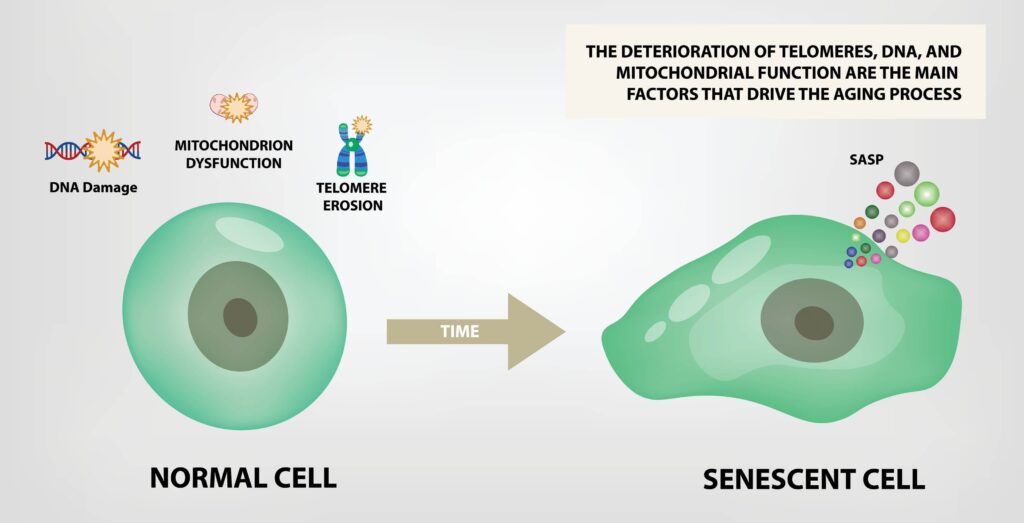
Cellular senescence is a natural biological process in which a cell permanently stops dividing while remaining alive and metabolically active. Rather than continuing to replicate after experiencing significant stress or damage, the cell enters a protective state that helps prevent the spread of damaged DNA and reduces the risk of cancer.
Scientists consider senescence to be a double-edged sword. Early in life, it plays an important role in normal development, wound healing, and protecting the body from potentially harmful cells. As we age, however, senescent cells can accumulate because the immune system becomes less efficient at removing them.
Although these cells no longer divide, they remain active and release a variety of signaling molecules, inflammatory proteins, and growth factors known collectively as the Senescence-Associated Secretory Phenotype (SASP). Over time, the buildup of these signals may contribute to chronic, low-grade inflammation and changes in the surrounding tissue environment.
Cellular senescence has been linked to several biological processes associated with aging, including reduced tissue repair, stem cell dysfunction, and changes in metabolic health. Because of its widespread influence throughout the body, it is recognized as one of the Hallmarks of Aging and has become a major focus of longevity research.
Researchers are actively studying why senescent cells accumulate, how they influence age-related diseases, and whether therapies that selectively remove or modify these cells may help improve healthspan. While this area of research is advancing rapidly, many potential interventions remain experimental and continue to be evaluated in laboratory and clinical studies.
Key Takeaways
- Cellular senescence is a permanent state in which a cell stops dividing but remains alive.
- It serves as an important protective mechanism against damaged or potentially cancerous cells.
- Senescent cells naturally increase with age.
- These cells release inflammatory signaling molecules known as SASP.
- The accumulation of senescent cells is considered one of the Hallmarks of Aging and is an active area of longevity research.
Scientific References
- López-Otín C, Blasco MA, Partridge L, Serrano M, Kroemer G. The Hallmarks of Aging. Cell. 2013;153(6):1194–1217.
- López-Otín C, Blasco MA, Partridge L, Serrano M, Kroemer G, et al. Hallmarks of Aging: An Expanding Universe. Cell. 2023;186(2):243–278.
- Gorgoulis VG, Adams PD, Alimonti A, et al. Cellular Senescence: Defining a Path Forward. Cell. 2022;185(15):2736–2778.
- Kirkland JL, Tchkonia T. Senolytic Drugs: From Discovery to Translation. Journal of Internal Medicine. 2020;288(5):518–536.
Last reviewed: July 2026