
Could a tiny peptide produced by our own mitochondria help explain why exercise protects against metabolic decline—and eventually inspire a new generation of longevity therapies?
For decades, scientists viewed mitochondria primarily as the energy-producing machinery inside our cells. Their job seemed straightforward: convert nutrients into ATP, the cellular fuel that powers everything from muscle contraction to brain activity. But an emerging area of longevity research is challenging that description. Mitochondria don’t simply produce energy. They also communicate with the rest of the cell, helping coordinate metabolism, stress responses, and adaptation to changing conditions.
One of the most intriguing discoveries in this field is MOTS-c, a naturally occurring peptide encoded by mitochondrial DNA. Research suggests that MOTS-c participates in pathways involved in insulin sensitivity, cellular energy regulation, and physical performance. In experimental animals, administering the peptide has improved several measures of metabolic health and exercise capacity, including in older mice.
Now, research published in 2025 and 2026 is adding new dimensions to the story, from pancreatic cell aging to mitochondrial efficiency in skeletal muscle. The excitement is understandable. But so is the need for caution: MOTS-c is not an established human anti-aging treatment, and its benefits from experimental administration have not been demonstrated in controlled human clinical trials.
What Is MOTS-c, and Why Are Longevity Researchers Interested?
MOTS-c stands for mitochondrial open reading frame of the 12S rRNA type-c. It is a small peptide composed of just 16 amino acids and was first characterized in a landmark 2015 study published in Cell Metabolism.
Unlike many familiar signaling molecules, MOTS-c is encoded by mitochondrial DNA rather than nuclear DNA. That distinction matters because it supports an expanding view of mitochondria as active participants in cellular communication—not merely passive energy producers.
MOTS-c belongs to a family called mitochondrial-derived peptides, or MDPs. These molecules appear to help coordinate responses to metabolic stress, including changes in nutrient availability, energy demand, and cellular damage. MOTS-c is especially interesting because its biological effects overlap with several processes associated with exercise and healthy aging.
The original 2015 research found that MOTS-c influenced glucose metabolism and insulin sensitivity through pathways involving AMPK, a major regulator of cellular energy balance. In mice, MOTS-c treatment also protected against some metabolic effects of high-fat feeding and aging.
That discovery raised a fascinating possibility: mitochondria may produce their own signaling molecules that help the body maintain metabolic flexibility as it ages.
Can MOTS-c Mimic Some of the Benefits of Exercise?
Possibly in experimental models, but calling MOTS-c an exercise replacement would go far beyond the available evidence.
One of the most compelling studies appeared in Nature Communications in 2021. Researchers investigated whether MOTS-c influenced physical performance and age-related muscle decline. Their experiments included young, middle-aged, and older mice, along with a small human exercise study.
The human findings were particularly interesting. Following a cycling exercise session, researchers observed an approximately 11.9-fold increase in measured MOTS-c levels in skeletal muscle, while circulating MOTS-c increased approximately 1.5- to 1.6-fold during and immediately after exercise. Circulating levels subsequently returned toward baseline during recovery.
This was not evidence that injected MOTS-c improves human exercise performance. It was evidence that the body naturally responds to exercise by changing MOTS-c signaling.
In mice, however, the researchers went further. Administering MOTS-c improved physical performance across different ages, and intermittent treatment initiated late in life improved measures of physical capacity in very old animals.
Think about what makes this scientifically interesting. Exercise is not beneficial simply because it burns calories. It activates an extensive network of molecular adaptations that influence mitochondrial function, glucose handling, muscle metabolism, and cellular resilience. MOTS-c may be one participant in that network.
The exciting research question is whether scientists can eventually harness selected components of those pathways therapeutically, especially for people experiencing age-related metabolic or physical decline.
How Does MOTS-c Work? The Connection to AMPK and Cellular Energy
To understand the mechanism, we need to look at one of the most important molecular systems in metabolic biology: AMPK, or AMP-activated protein kinase.
AMPK functions as a cellular energy sensor. When cells experience energetic stress, AMPK helps coordinate responses that restore energy balance, including changes in glucose uptake, fat metabolism, and energy-consuming processes.
Research indicates that MOTS-c can influence AMPK signaling through a pathway involving folate metabolism and purine synthesis. In the original mechanistic work, MOTS-c interfered with aspects of de novo purine synthesis, contributing to metabolic conditions that activate AMPK.
MOTS-c also has an unusual additional feature: under certain stress conditions, it can relocate to the cell nucleus, where it influences the expression of genes involved in stress adaptation. This suggests a direct connection between mitochondrial signals and the nuclear programs that regulate cellular behavior.
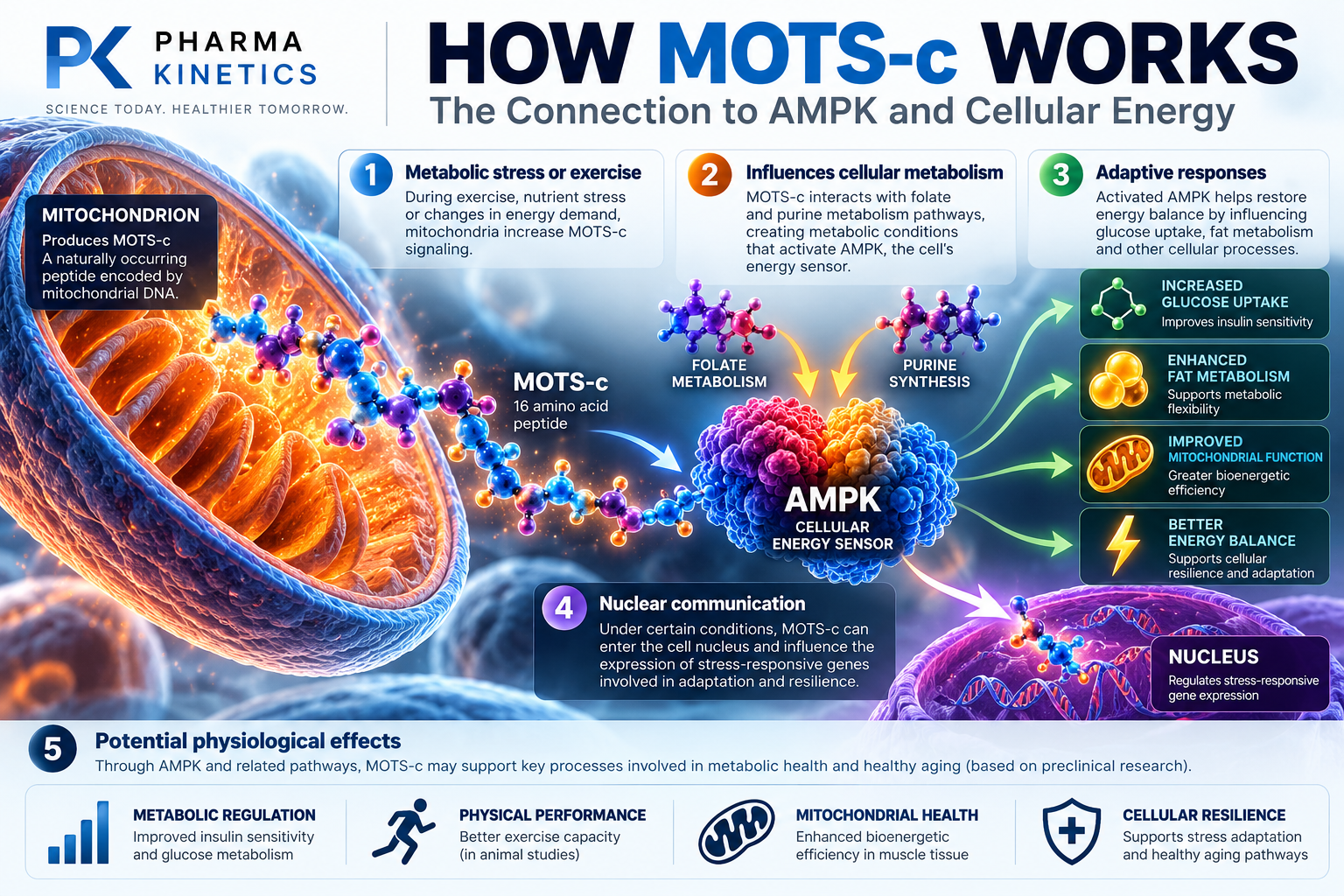
The proposed MOTS-c signaling pathway
- Metabolic stress or exercise: Cellular conditions change, and endogenous MOTS-c signaling may increase.
- Metabolic pathway regulation: MOTS-c influences folate and purine metabolism, contributing to AMPK activation in experimental systems.
- Adaptive cellular responses: AMPK and related pathways influence nutrient utilization, metabolic balance, and stress adaptation.
- Nuclear communication: MOTS-c can enter the nucleus under certain conditions and participate in regulating stress-responsive gene expression.
- Potential physiological effects: Animal studies report improvements in selected measures of glucose regulation, physical capacity, and metabolic health.
These steps represent a developing mechanistic model rather than a fully established sequence of effects in humans.
The 2026 Discovery: MOTS-c and Mitochondrial Efficiency
One of the more interesting developments is a 2026 study published in Free Radical Biology and Medicine, titled MOTS-c improves intrinsic muscle mitochondrial bioenergetic health and efficiency in a PGC-1α/AMPK-dependent manner.
The study expands the scientific discussion beyond glucose regulation and exercise performance toward the machinery responsible for cellular energy production itself.
Two major molecular players are particularly relevant: AMPK, which responds to cellular energy stress, and PGC-1α, a regulator involved in mitochondrial adaptation and energy metabolism.
The importance of this research direction is that aging-related metabolic dysfunction may involve not only how much energy cells produce, but also how effectively mitochondria respond to physiological demands.
If future research establishes that MOTS-c can reliably improve mitochondrial function in humans, its potential applications could extend beyond weight management into broader questions of muscle health and metabolic resilience.
However, the study’s mechanistic findings should not be interpreted as evidence that MOTS-c injections improve human longevity, VO₂max, or everyday energy levels.
Could MOTS-c Help Protect Against Diabetes and Cellular Aging?
A 2025 study published in Experimental & Molecular Medicine introduced another potentially important connection: pancreatic beta-cell senescence.
Beta cells are responsible for producing insulin. As metabolic disease and aging progress, these cells may experience dysfunction and senescence, a state in which cells undergo persistent changes in function and stress signaling.
Researchers reported that MOTS-c levels declined in aging and senescent pancreatic islet cells. In experimental mouse models, MOTS-c treatment reduced several indicators of pancreatic islet senescence and improved aspects of glucose regulation.
The study also found that people with type 2 diabetes had lower circulating MOTS-c levels than healthy controls.
That human observation is intriguing, but it does not establish cause and effect. Lower MOTS-c might contribute to metabolic dysfunction, result from it, or reflect other physiological differences.
The larger implication is that MOTS-c research is moving into an especially important area of longevity biology: preserving cellular function rather than simply treating the downstream symptoms of metabolic disease.
MOTS-c vs. GLP-1 Drugs: Are They Targeting Different Problems?
The comparison with GLP-1 medications is inevitable, especially as metabolic therapies such as semaglutide, tirzepatide, and investigational retatrutide continue to attract attention.
But MOTS-c and GLP-1-based drugs are fundamentally different scientific stories.
GLP-1-based therapies act through specific hormone receptors and have demonstrated clinically meaningful effects on appetite, glucose regulation, and weight loss. Certain approved drugs also have established benefits for selected cardiovascular and other clinical outcomes.
MOTS-c, by contrast, is being investigated primarily as a mitochondrial signaling peptide that influences cellular metabolism and stress adaptation.
| Feature | MOTS-c | GLP-1 Therapies |
|---|---|---|
| Primary research focus | Cellular metabolism and stress responses | Appetite, glucose control, metabolic disease |
| Key mechanisms | AMPK, metabolic signaling, nuclear stress responses | GLP-1 receptor signaling and related pathways |
| Human efficacy evidence | Not established for administered MOTS-c | Extensive randomized trials for approved agents |
| Weight-loss evidence | Preclinical findings | Established for certain approved medications |
| Longevity implications | Experimental and hypothesis-generating | Some proven disease-risk benefits; no proof of extending maximum human lifespan |
The real opportunity may not be deciding which molecule is better. It may be understanding how distinct metabolic pathways interact and whether future treatments can address multiple aspects of age-related dysfunction.
Is MOTS-c Really an Anti-Aging Peptide?
MOTS-c is a promising longevity research candidate, not a proven anti-aging therapy.
That distinction is especially important because the word longevity is frequently used to describe very different outcomes. Extending lifespan, preventing disease, improving metabolic biomarkers, and maintaining physical performance with age are related goals, but they are not interchangeable.
Animal studies have reported improvements in physical capacity and selected metabolic outcomes after MOTS-c administration. Other experiments suggest effects on cellular stress signaling and age-associated dysfunction.
What has not been established is that administering MOTS-c extends human lifespan, reverses biological aging, prevents cardiovascular events, or reliably improves clinical outcomes in people.
Even the phrase exercise mimetic requires context. Exercise produces adaptations throughout the cardiovascular, muscular, nervous, skeletal, and metabolic systems. A peptide that influences one or several exercise-responsive pathways cannot be assumed to reproduce that entire physiological experience.
A more accurate description is that MOTS-c may participate in some of the molecular adaptations associated with exercise and metabolic stress.
What Are the Risks of Using MOTS-c?
This is where the gap between scientific research and online peptide culture becomes particularly important.
MOTS-c is not an FDA-approved medication, and standardized human therapeutic dosing, long-term safety, and clinical efficacy have not been established.
Online discussions sometimes treat experimental peptides as if promising mouse data were sufficient justification for self-experimentation. They are not.
Important unanswered questions include how administered MOTS-c behaves in humans, whether repeated exposure produces unintended metabolic effects, what adverse events might occur, and whether benefits persist over time. Product purity and sterility introduce additional risks when substances are obtained outside regulated pharmaceutical supply chains.
Until adequately controlled human studies establish appropriate safety and efficacy, claims that MOTS-c injections are a reliable treatment for aging, insulin resistance, or exercise performance remain unsupported.
Can You Increase MOTS-c Naturally?
Exercise is the most directly supported physiological stimulus for increasing endogenous MOTS-c in humans.
The 2021 human cycling study demonstrated acute changes in skeletal muscle and circulating MOTS-c following exercise. Other research has investigated how exercise intensity, duration, and training status influence mitochondrial-derived peptides, although results across studies remain variable.
A 2026 systematic review of exercise-related mitochondrial-derived peptides also found generally encouraging patterns but emphasized the small evidence base and substantial differences between studies.
There is currently insufficient evidence to prescribe a specific exercise protocol solely to maximize MOTS-c or to conclude that increasing circulating MOTS-c is itself a validated health objective.
Fortunately, regular physical activity already has extensive clinical evidence supporting metabolic and cardiovascular health, independent of whether MOTS-c ultimately becomes a therapeutic target.
The Bigger Picture: Are Mitochondria Becoming the Next Frontier in Longevity Medicine?
The most important story here may be larger than MOTS-c itself.
Mitochondria are increasingly understood as signaling centers that help coordinate how cells respond to energy availability, stress, and physiological demand. Their influence extends into pathways involving AMPK, mitochondrial biogenesis, cellular quality control, and potentially age-related disease processes.
MOTS-c provides a particularly compelling example because it connects mitochondrial genetics with whole-body metabolic regulation.
For researchers, this opens questions that were difficult to imagine when mitochondria were described primarily as cellular power plants. Could mitochondrial-derived signals become therapeutic targets? Could they help preserve metabolic function as we age? Could certain pathways eventually support healthier skeletal muscle or improve resilience against metabolic disease?
Those are scientifically legitimate questions. They are not yet clinical promises.
Connecting the Dots: Why MOTS-c Matters
For PharmaKinetics, the most compelling aspect of MOTS-c is not the idea of a miracle anti-aging injection. It is the possibility that mitochondria possess a sophisticated communication system that helps determine how the body adapts to metabolic challenges.
Exercise, insulin sensitivity, mitochondrial efficiency, and cellular stress resistance are deeply interconnected. MOTS-c appears to sit at an interesting intersection of those processes.
The 2015 discovery established its metabolic signaling potential. The 2021 research connected it to exercise and age-related physical performance. Studies in 2025 and 2026 have expanded the conversation toward pancreatic cell senescence and mitochondrial bioenergetics.
The next breakthrough won’t be another influencer calling MOTS-c the fountain of youth. It will be a well-controlled human clinical trial demonstrating whether manipulating this pathway actually improves health.
Until then, MOTS-c remains one of the more fascinating experimental peptides in mitochondrial and metabolic longevity research—and a reminder that the biology of aging is far more complex than any single molecule.
Frequently Asked Questions About MOTS-c
What does MOTS-c stand for?
MOTS-c stands for mitochondrial open reading frame of the 12S rRNA type-c. It is a naturally occurring, 16-amino-acid peptide encoded by mitochondrial DNA.
Does MOTS-c activate AMPK?
Preclinical research indicates that MOTS-c can activate AMPK-related signaling through changes in cellular metabolism, including folate and purine pathways. The clinical importance of this mechanism in humans remains under investigation.
Does MOTS-c help burn visceral fat?
Animal research has reported reductions in diet-induced fat accumulation and improvements in metabolic regulation. There is no established clinical evidence that administering MOTS-c specifically reduces human visceral fat.
Can MOTS-c increase VO₂max?
No controlled human clinical evidence currently establishes that administered MOTS-c increases VO₂max. Improved physical performance in experimental mice does not establish a similar benefit in humans.
Is MOTS-c FDA-approved?
No. MOTS-c is not an FDA-approved medication for weight loss, longevity, insulin resistance, or exercise performance.
Is MOTS-c better than semaglutide or retatrutide?
There is no credible clinical basis for ranking MOTS-c above these drugs. They act through different mechanisms, and MOTS-c lacks the human efficacy evidence needed for meaningful comparisons.
Scientific References
- Lee C, et al. (2015). The mitochondrial-derived peptide MOTS-c promotes metabolic homeostasis and reduces obesity and insulin resistance. Cell Metabolism. https://pubmed.ncbi.nlm.nih.gov/25738459/
- Reynolds JC, et al. (2021). MOTS-c is an exercise-induced mitochondrial-encoded regulator of age-dependent physical decline and muscle homeostasis. Nature Communications. https://doi.org/10.1038/s41467-020-20790-0
- Exercise, Mitohormesis, and Mitochondrial ORF of the 12S rRNA Type-C (MOTS-c). (2022). https://pubmed.ncbi.nlm.nih.gov/35656563/
- Mitochondria-derived peptide MOTS-c: effects and mechanisms related to stress, metabolism and aging. (2023). https://pubmed.ncbi.nlm.nih.gov/36670507/
- Mitochondrial-encoded peptide MOTS-c prevents pancreatic islet cell senescence to delay diabetes. (2025). Experimental & Molecular Medicine. https://doi.org/10.1038/s12276-025-01521-1
- Gudiksen A, et al. (2026). MOTS-c improves intrinsic muscle mitochondrial bioenergetic health and efficiency in a PGC-1α/AMPK-dependent manner. Free Radical Biology and Medicine. https://pubmed.ncbi.nlm.nih.gov/41520850/
- Mitochondrial-derived peptides (MDPs) activated by physical exercise as therapeutic targets for metabolic disorders: A systematic review. (2026). https://pubmed.ncbi.nlm.nih.gov/42640735/