
Quick Definition
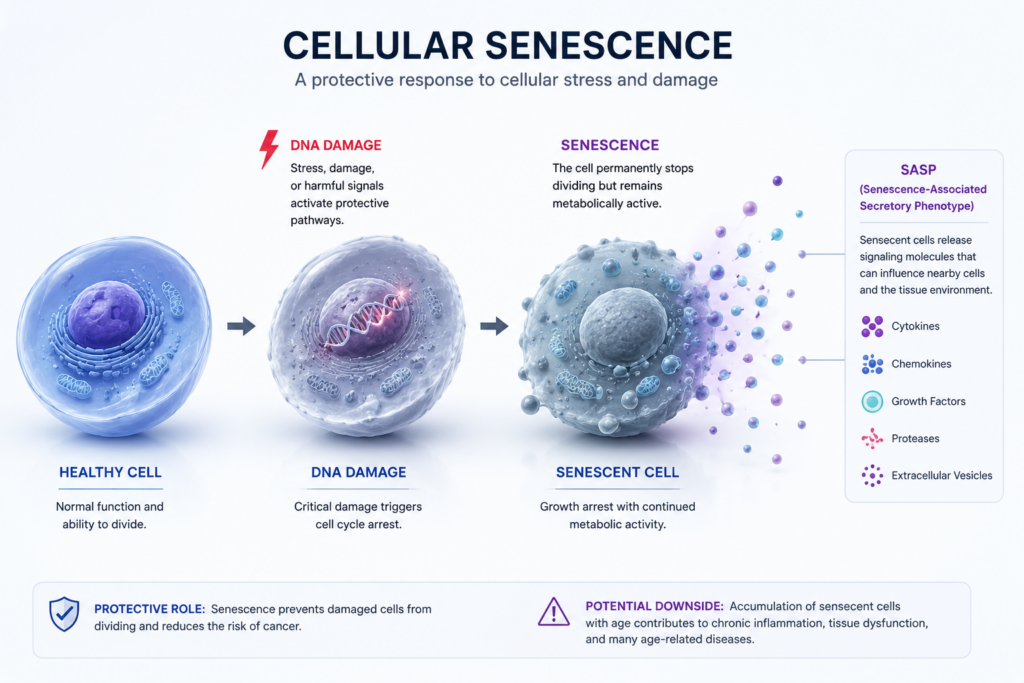
Cellular senescence is a biological process in which a cell permanently stops dividing but remains alive and metabolically active. Unlike healthy cells that continue to grow and replace damaged tissue, senescent cells enter a protective state in response to stress, DNA damage, or other forms of cellular injury. Scientists believe this process helps prevent damaged cells from becoming cancerous, but the accumulation of senescent cells over time may also contribute to aging and many age-related diseases.
At a Glance
Before exploring the biology of senescence, here are the most important concepts to understand.
- Senescence is a natural protective response that prevents damaged cells from continuing to divide.
- Senescent cells remain alive and continue communicating with nearby cells through chemical signals.
- Temporary senescence is beneficial and supports normal wound healing and tissue repair.
- As senescent cells accumulate with age, they may contribute to chronic inflammation and declining tissue function.
- Senescence is one of the Hallmarks of Aging and is a major focus of longevity and healthy aging research.
Biological Significance
Senescence is one of the body’s built-in protective mechanisms. When a cell experiences significant damage, permanently stopping cell division is often safer than allowing that damaged cell to continue multiplying. This helps reduce the risk of cancer by preventing cells with damaged DNA from producing new cells that carry the same defects.
Beyond cancer prevention, senescence also plays important roles in normal biology. During wound healing, temporary senescent cells help coordinate tissue repair by releasing signaling molecules that attract immune cells and promote healing.
The challenge comes when senescent cells are not efficiently removed. As they accumulate over time, they can disrupt normal tissue function, contribute to chronic inflammation, and influence many of the biological changes associated with aging.
How It Works
Healthy cells normally divide to replace damaged or aging tissue. When a cell experiences excessive stress—such as DNA damage, oxidative stress, shortened telomeres, or repeated cell division—it activates protective molecular pathways.
One of the first responders is p53, a protein often called the guardian of the genome because it helps detect DNA damage and determine whether a cell should repair itself, stop dividing, or undergo programmed cell death.
If the damage cannot be safely repaired, proteins including p21 and p16INK4a permanently stop the cell cycle, placing the cell into senescence.
Although these cells no longer divide, they remain metabolically active. Many begin releasing inflammatory proteins, growth factors, and signaling molecules known collectively as the Senescence-Associated Secretory Phenotype (SASP). These signals help coordinate tissue repair but may also promote chronic inflammation when senescent cells accumulate over time.
Current Research
Research into senescence has grown rapidly because of its potential role in healthy aging.
Scientists are currently investigating:
- How senescent cells accumulate in different tissues throughout life.
- Why the immune system becomes less effective at removing senescent cells with age.
- How SASP influences inflammation and neighboring healthy cells.
- Whether reducing the burden of senescent cells can improve healthspan.
- Senolytics, compounds designed to selectively eliminate senescent cells.
- Senomorphics, compounds that aim to change the behavior of senescent cells without removing them.
While early research has produced promising results in laboratory and animal studies, many approaches are still being evaluated to determine their safety and effectiveness in humans.
Connecting the Dots
Senescence is closely connected to many of the biological systems that influence aging and overall health. Understanding this process provides a foundation for exploring several other important topics within the Pharmakinetics Knowledge Library.
Related concepts include:
- Autophagy, which helps remove damaged cellular components before they accumulate.
- DNA Repair, the collection of cellular mechanisms that correct genetic damage.
- Mitochondria, whose dysfunction can increase cellular stress and trigger senescence.
- Telomeres, protective structures that shorten as cells divide and can initiate senescence.
- Stem Cells, whose regenerative capacity may decline as senescent cells accumulate.
- Inflammation, particularly the chronic, low-grade inflammation associated with aging.
Together, these interconnected systems help explain why senescence has become one of the central topics in modern longevity research.
Related Topics
- Autophagy
- Apoptosis
- DNA Repair
- Mitochondria
- Stem Cells
- Telomeres
- Oxidative Stress
- Cellular Aging
- Senescence-Associated Secretory Phenotype (SASP)
- Senolytics
References
- López-Otín C, Blasco MA, Partridge L, Serrano M, Kroemer G. The Hallmarks of Aging. Cell. 2013;153(6):1194-1217.
- López-Otín C, Blasco MA, Partridge L, Serrano M, Kroemer G. Hallmarks of Aging: An Expanding Universe. Cell. 2023;186(2):243-278.
- Campisi J. Cellular Senescence and Lung Function During Aging. Yale Journal of Biology and Medicine. 2016.
- van Deursen JM. The Role of Senescent Cells in Ageing. Nature. 2014;509:439-446.