
Retatrutide has generated excitement because of the amount of weight loss seen in clinical trials. But alongside the headlines, another question has emerged: If retatrutide raises your resting heart rate, could it also increase your risk of a heart attack or other cardiovascular problems?
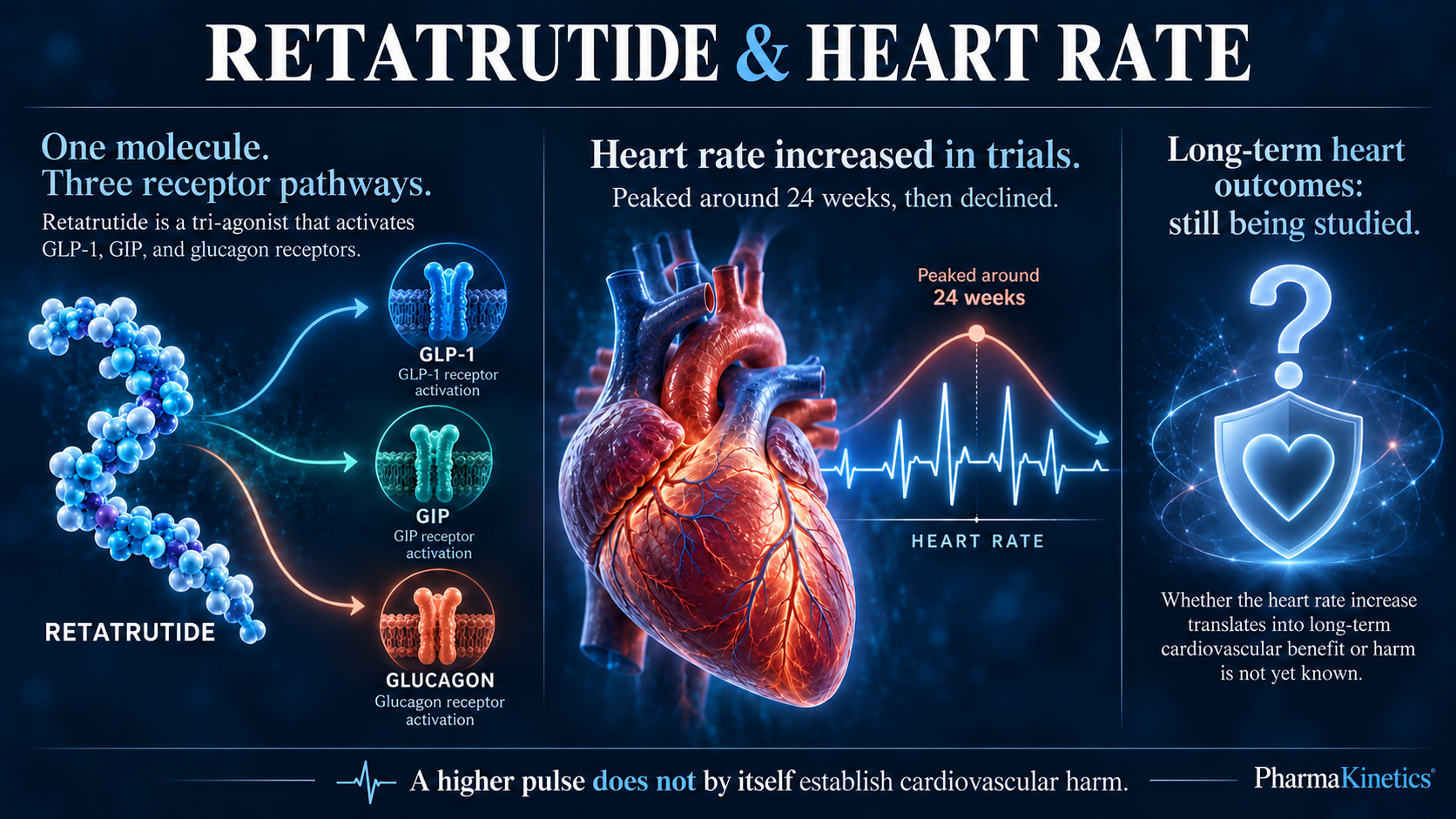
The short answer is that retatrutide has been shown to increase heart rate in clinical trials, but researchers do not yet know what that increase means for long-term cardiovascular outcomes. A higher pulse alone cannot tell us whether the drug will ultimately increase, decrease, or have no effect on the risk of heart attack, stroke, or cardiovascular death. A large outcomes trial is underway to help answer that question.
What Is Retatrutide and How Does It Work?
Retatrutide, often called “reta,” is an investigational medication designed to activate three hormone receptors involved in metabolic regulation: GLP-1, GIP, and glucagon. These signaling pathways influence appetite, blood sugar regulation, and energy metabolism.
This combination distinguishes retatrutide from semaglutide, which targets GLP-1 receptors, and tirzepatide, which targets both GLP-1 and GIP receptors. By adding glucagon receptor activity, researchers hope to affect energy expenditure as well as appetite and metabolic function. Retatrutide remains under investigation and is not FDA-approved for weight management. [1, 2]
Does Retatrutide Increase Resting Heart Rate?
Yes. In a phase 2 obesity trial, retatrutide increased heart rate in a dose-dependent pattern: Higher doses generally produced larger increases. The average increase peaked around 24 weeks and then declined at later measurements through week 48. That pattern describes the group average; it does not mean every participant experienced the same change or returned to their starting heart rate. [1]
The researchers noted that the increases observed in this trial were similar to those reported with GLP-1 receptor agonists. However, comparisons across separate studies have limitations, and the size of a heart-rate change can vary with the medication, dose, population, and how heart rate is measured.
The finding is worth watching, but it is also important to put it in context. A change in a measurement is not the same thing as proof of a harmful clinical outcome. To understand the latter, researchers need to track events such as heart attacks, strokes, hospitalizations, and cardiovascular deaths over time.
Why Might Retatrutide Raise Heart Rate?
Retatrutide’s effect on heart rate may involve several mechanisms. One possibility is its activity at the glucagon receptor. Glucagon has effects on the cardiovascular system and can increase heart rate under certain circumstances. GLP-1 receptor activity has also been associated with increases in heart rate, so the response should not be attributed to glucagon alone without further evidence.
The crucial distinction is that a biologically plausible explanation is not the same as a proven explanation for the full effect observed in patients. Researchers are still studying how the drug’s combined receptor activity, weight loss, and other physiological changes interact over time.
Does a Higher Resting Heart Rate Mean a Higher Risk of Death?
In the general population, a higher resting heart rate has been associated with a greater risk of death. One meta-analysis pooled data from 46 prospective studies and found that, on average, each 10-beat-per-minute higher resting heart rate was associated with a 9% higher relative risk of death from any cause. [3]
That finding sounds alarming, but it does not mean that a drug-induced increase of 10 beats per minute causes a 9% increase in mortality. The studies observed people over time; they did not randomly assign people to have a higher heart rate. Resting heart rate can also reflect factors such as fitness, underlying illness, medications, stress, and smoking. Statistical adjustments can account for some differences between people, but they cannot prove that heart rate itself caused the observed increase in risk.
The takeaway: The population-level association is a reason to investigate, not a formula for calculating an individual’s risk from retatrutide.
What Can Semaglutide Teach Us About Heart Rate and Heart Health?
Semaglutide offers an example of why a drug’s overall cardiovascular effects cannot be judged by heart rate alone. In the large SELECT trial, researchers studied adults aged 45 and older who had overweight or obesity, established cardiovascular disease, and no diabetes. Participants receiving semaglutide had a 20% lower relative risk of the combined outcome of cardiovascular death, nonfatal heart attack, or nonfatal stroke compared with those receiving placebo. [4]
That result does not prove that retatrutide will have the same benefit. The two drugs act on different combinations of receptors and need to be evaluated separately. It does show why researchers must look beyond a single biomarker and measure actual cardiovascular outcomes.
What Do the Newer Retatrutide Trials Show?
Research has progressed beyond the original phase 2 study. In the phase 3 TRIUMPH-1 trial, adults with obesity without diabetes received retatrutide or placebo for 80 weeks. The published results showed substantial average weight loss with retatrutide compared with placebo. The trial adds to the evidence on the drug’s effects and safety, but it does not replace a dedicated, long-term cardiovascular outcomes study. [5]
A separate phase 3 study, TRIUMPH-OUTCOMES, is examining cardiovascular and kidney outcomes in adults with overweight or obesity and established atherosclerotic cardiovascular disease and/or chronic kidney disease. Its estimated completion is February 2029, although projected trial dates can change. [6]
Is Retatrutide Safe for People With Heart Disease?
There is not yet enough dedicated outcomes evidence to say what retatrutide’s long-term cardiovascular effect will be in people with heart disease. Individual risk also depends on the type of heart condition, medications, symptoms, and other factors—not just resting heart rate.
Anyone considering a weight-management medication should discuss their medical history with a qualified healthcare professional, especially if they have heart failure, an abnormal heart rhythm, unexplained shortness of breath, or a history of cardiovascular disease. A clinician can help assess whether an approved treatment is appropriate and what monitoring may be needed.
Is Retatrutide Approved or Available to Buy?
As of October 2026, retatrutide is investigational and has not been approved by the FDA. The FDA has warned about companies illegally selling unapproved products containing retatrutide, including products labeled “for research purposes” or “not for human consumption.” Such labels do not establish that a product is safe or suitable for human use. [2]
People interested in retatrutide should look to legitimate clinical trials and speak with a qualified healthcare professional about available, approved treatment options.
The Bottom Line: What Does Retatrutide’s Heart-Rate Increase Mean?
Retatrutide can raise heart rate, and that finding deserves careful follow-up. But the current evidence does not support claiming that the increase directly translates into a specific percentage increase in mortality—or that it proves the drug causes heart attacks. Likewise, promising weight-loss results do not establish that it protects the heart.
The most useful answer will come from trials that measure cardiovascular events directly. Until those results are available, the responsible conclusion is that retatrutide’s long-term cardiovascular effects remain an open question.
Frequently Asked Questions
How much does retatrutide raise heart rate?
In the phase 2 obesity trial, the average increase varied by dose, with higher doses generally producing larger increases. The increase peaked around 24 weeks and declined afterward. Individual responses may differ. [1]
Does retatrutide cause heart attacks?
Current evidence does not establish that retatrutide causes heart attacks, but its long-term effect on major cardiovascular events remains under investigation. The ongoing TRIUMPH-OUTCOMES trial is designed to provide more information. [6]
Does a higher resting heart rate always mean a medication is bad for the heart?
No. Heart rate is one measure, and its meaning depends on the cause and the person’s health. Researchers also need to study clinical outcomes such as heart attacks, strokes, and cardiovascular deaths.
Is retatrutide the same as semaglutide?
No. Semaglutide activates the GLP-1 receptor. Retatrutide is being studied as an agonist of three receptors: GLP-1, GIP, and glucagon. Their effects and safety outcomes must be evaluated separately.
References
- Jastreboff AM, et al. Triple–Hormone-Receptor Agonist Retatrutide for Obesity — A Phase 2 Trial. New England Journal of Medicine. 2023.
- U.S. Food and Drug Administration. FDA’s Concerns with Unapproved GLP-1 Drugs Used for Weight Loss.
- Zhang D, et al. Resting Heart Rate and All-Cause and Cardiovascular Mortality in the General Population: A Meta-Analysis. CMAJ. 2016.
- Lincoff AM, et al. Semaglutide and Cardiovascular Outcomes in Obesity without Diabetes. New England Journal of Medicine. 2023.
- Retatrutide, a Triple Hormone Receptor Agonist, for Treatment of Obesity. New England Journal of Medicine. 2026.
- Eli Lilly and Company. TRIUMPH-OUTCOMES: The Effect of Retatrutide on Cardiovascular and Kidney Outcomes.