
An experimental drug called CBL-514 is exploring a different approach to fat reduction: triggering programmed fat-cell death. Recent clinical research raises intriguing questions about visceral fat, weight regain, and the future of metabolic medicine.
Can You Actually Kill Fat Cells?
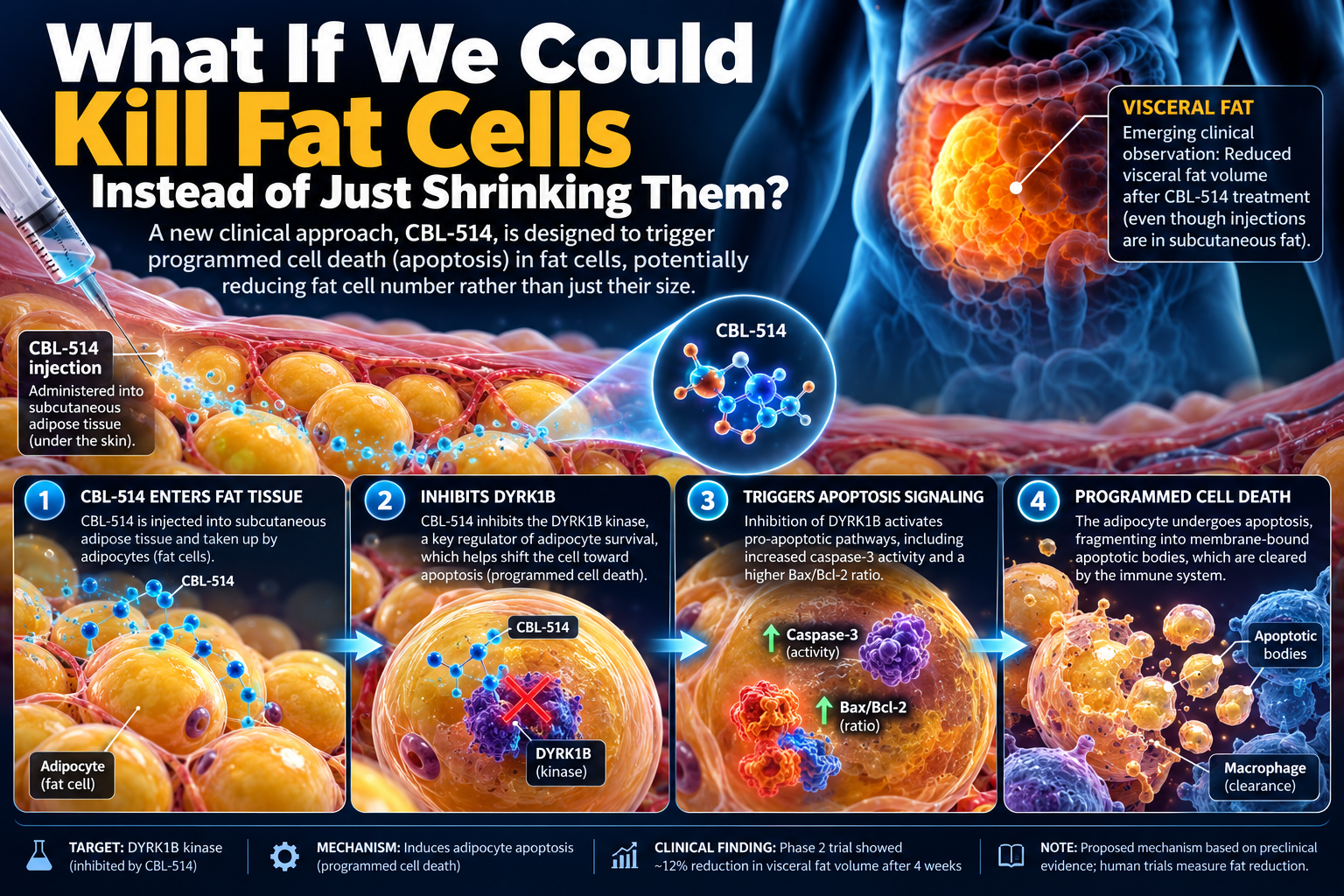
Yes. Fat cells, also called adipocytes, can undergo apoptosis, a natural process of programmed cell death. Researchers are now investigating whether this biological mechanism can be deliberately activated to reduce unwanted fat tissue. One experimental treatment attracting attention is CBL-514, an injectable small-molecule drug being developed to reduce localized fat deposits. Unlike conventional weight loss, which generally makes existing fat cells smaller, CBL-514 is designed to reduce the number of fat cells through apoptosis.
Recent Phase 2 clinical research suggests that CBL-514 can reduce abdominal subcutaneous fat. Exploratory findings presented in October 2026 also reported reductions in visceral fat, the deeper abdominal fat associated with metabolic and cardiovascular risk. However, CBL-514 remains investigational. Its long-term effectiveness, safety, and potential role in treating metabolic disease have not been established.
What Is CBL-514 and How Does It Work?
CBL-514 is an experimental injectable drug developed by Caliway Biopharmaceuticals to target adipose tissue. Its proposed mechanism involves inhibiting an enzyme called DYRK1B, which participates in cellular signaling and survival. Preclinical research suggests this inhibition promotes apoptosis through changes in proteins that regulate programmed cell death.
The proposed sequence involves four steps:
- Injection into subcutaneous fat: CBL-514 is administered directly into targeted fat tissue.
- DYRK1B inhibition: The compound interferes with signaling associated with adipocyte survival.
- Activation of apoptosis pathways: Increased caspase-3 activity and changes in the Bax/Bcl-2 ratio favor programmed cell death.
- Cellular clearance: Dying adipocytes fragment into smaller structures that can be removed by the body’s cellular clearance mechanisms.
The objective is to eliminate targeted adipocytes rather than merely reduce the triglycerides stored inside them. These molecular mechanisms are primarily supported by preclinical evidence. Human trials have measured fat-volume changes but have not independently confirmed every step of the proposed pathway.
What Do Clinical Trials Show About CBL-514?
Human clinical trials have reported reductions in localized abdominal fat following CBL-514 injections. In a randomized, placebo-controlled Phase 2 trial published in Aesthetic Surgery Journal, 69.6% of treated participants achieved a reduction of at least 150 mL of abdominal subcutaneous fat at the eight-week follow-up, compared with 0% in the placebo group.
A subsequent Phase 2b trial reported approximately 20.3% average reduction in MRI-measured abdominal fat volume among evaluated participants receiving CBL-514. These findings support continued investigation of adipocyte apoptosis as a potential method for targeted fat reduction. They do not establish that CBL-514 is an effective treatment for generalized obesity or that it improves long-term metabolic outcomes.
Does CBL-514 Reduce Visceral Fat?
Preliminary clinical findings suggest CBL-514 may reduce visceral fat, but the evidence is not yet conclusive. At the October 2026 European Association for the Study of Diabetes (EASD) meeting, researchers presented an exploratory analysis of Phase 2 trial data examining changes in visceral adipose tissue.
Four weeks after treatment, investigators reported:
| Treatment group | Change in visceral fat volume |
|---|---|
| CBL-514 | −12.01% |
| Placebo | +5.68% |
The difference between groups was approximately 17.7 percentage points. This result is particularly interesting because CBL-514 was injected into abdominal subcutaneous fat, not directly into the visceral fat surrounding internal organs. Researchers have not yet established why the deeper fat compartment appeared to change or whether the finding will be reproduced in larger trials.
Could CBL-514 Prevent Weight Regain After GLP-1 Treatment?
One of the major challenges with GLP-1-based weight-loss medications is that substantial weight regain can occur after treatment is discontinued. Medications such as semaglutide and tirzepatide influence appetite and metabolic signaling, helping patients reduce energy intake and body weight. But weight loss generally reduces the size of adipocytes rather than permanently eliminating all of the cells involved. That distinction has prompted researchers to investigate whether fat-cell apoptosis could complement existing obesity treatments.
In a preclinical animal study, combining CBL-514 with tirzepatide was associated with less weight regain after tirzepatide discontinuation. The concept is intriguing: a treatment that reduces appetite might someday be paired with another therapy designed to reduce fat-cell numbers. However, no human clinical trial has established that CBL-514 prevents weight regain following GLP-1 discontinuation.
Is Fat-Cell Apoptosis Permanent?
Eliminating an adipocyte is different from shrinking it, but that does not mean the resulting fat reduction is necessarily permanent. The body can generate new fat cells through a process called adipogenesis. Fat tissue also performs important endocrine and metabolic functions. Adipocytes produce hormones and signaling molecules, including leptin and adiponectin, that help regulate appetite, insulin sensitivity, and energy balance.
Future studies must determine whether CBL-514 produces durable reductions in fat volume, how surrounding tissue responds, and whether new adipocytes eventually replace those eliminated. Long-term safety is equally important, particularly if researchers pursue applications beyond localized fat reduction.
Is CBL-514 a Peptide or GLP-1 Medication?
No. CBL-514 is an investigational small-molecule drug, not a peptide or GLP-1 receptor agonist. Its proposed mechanism is fundamentally different from peptide-based metabolic therapies. GLP-1 medications influence hormonal signaling involved in appetite and glucose regulation. CBL-514 is designed to trigger programmed cell death in adipocytes.
These approaches target different aspects of fat biology, which is why researchers are interested in whether they could eventually be complementary. That possibility should not be interpreted as evidence that combining these treatments is safe or effective in humans.
Clinical Research and References
- Efficacy and Safety of CBL-514 Injection in Reducing Abdominal Subcutaneous Fat. Aesthetic Surgery Journal, 2025. https://pmc.ncbi.nlm.nih.gov/articles/PMC12080885/
- Randomized Phase 2b Trial of CBL-514 Injection for Abdominal Subcutaneous Fat Reduction With Clinician- and Patient-Reported Outcomes and MRI Assessment. Aesthetic Surgery Journal, 2026. https://doi.org/10.1093/asj/sjag092
- New Weight-Loss Injection Targets Fat Cells. EASD 2026 conference research announcement. https://www.eurekalert.org/news-releases/1146063
- Science Media Centre. Expert Reaction to Phase 2 CBL-514 Trial Findings on Subcutaneous and Visceral Fat, October 2026. https://www.sciencemediacentre.org/expert-reaction-to-conference-abstract-about-a-phase-2-trial-of-a-new-weight-loss-injection-cbl-514-and-levels-of-subcutaneous-and-visceral-fat-presented-at-the-european-association-for-the-study-o/
Medical research disclaimer: CBL-514 is investigational and not FDA-approved. Preliminary trial findings should not be interpreted as established treatment benefits or clinical recommendations.