
Part 1 of the PharmaKinetics Tesamorelin Series
What is tesamorelin, and how does it work?
Tesamorelin is a synthetic version of growth hormone-releasing hormone, or GHRH. Its structure contains the full 44-amino-acid human GHRH sequence with a protective chemical modification at the front. The original research describes this added trans-3-hexenoyl group as a way to increase its half-life compared with native GHRH. Think of it as protecting the message long enough for it to reach its target. [2]
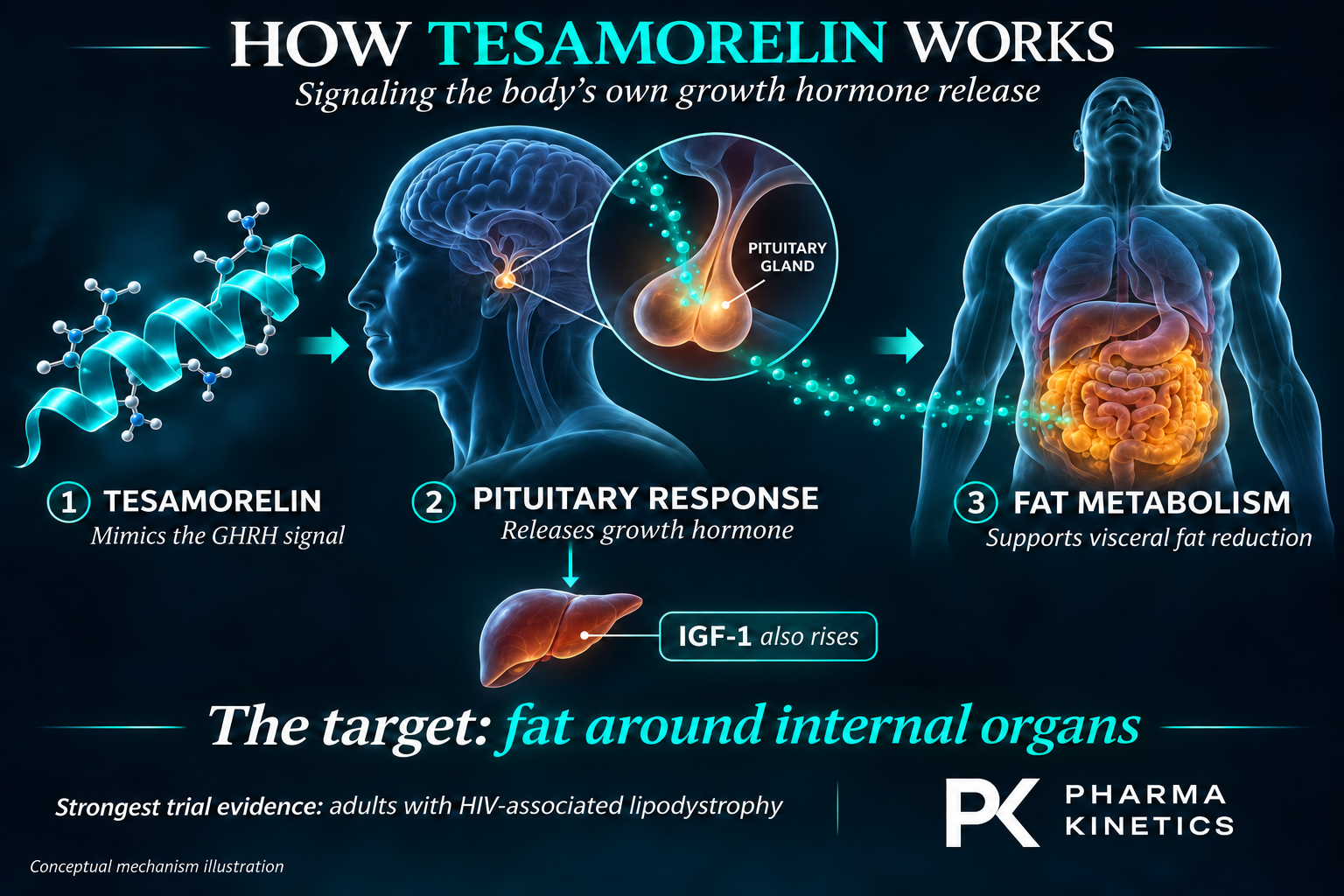
The target is the pituitary gland, which releases the body’s own growth hormone in response. Growth hormone affects fat metabolism and promotes production of insulin-like growth factor 1, or IGF-1. Tesamorelin therefore stimulates a hormonal pathway instead of supplying growth hormone directly. That distinction explains its mechanism; it does not remove its risks. [3]
Which belly fat changed in the trials?
Visceral adipose tissue, abbreviated VAT, sits inside the abdomen around internal organs. Subcutaneous fat lies beneath the skin. Researchers distinguish them because they are separate compartments with different relationships to metabolic health. Tesamorelin studies repeatedly found a reduction in visceral fat without a significant reduction in abdominal subcutaneous fat. A smaller visceral depot therefore does not guarantee that pinchable stomach fat or love handles will disappear. [4]
This is also why the measurement matters. The pivotal studies used computed tomography, or CT, to quantify visceral fat. Their headline endpoint was an imaging measurement of a particular abdominal fat compartment—not pounds lost or a photograph of someone’s waist. [2]
How much visceral fat did tesamorelin reduce?
The pooled phase 3 analysis included 806 adults receiving antiretroviral treatment for HIV. Participants were randomized two to one to tesamorelin or placebo during the initial 26 weeks. The pooled placebo-adjusted VAT effect was 15.4%. Among those continuing treatment through 52 weeks, the average reduction from the original baseline was approximately 17.5%, with an average waist reduction of 3.4 centimeters. These are group averages with substantial variation between people. [1]
Why the percentages in tesamorelin headlines differ
| Evidence | Result | What it means |
|---|---|---|
| 2007 phase 3 publication | VAT decreased 15.2% with treatment and increased 5.0% with placebo. | Change within each group at 26 weeks. [2] |
| Pooled phase 3 analysis | 15.4% treatment effect. | Comparison against placebo at 26 weeks. [1] |
| Continued treatment | VAT decreased approximately 17.5%. | Change from original baseline at 52 weeks. [1] |
The first trial’s 15.2% reduction and roughly 20-percentage-point gap between groups describe different comparisons. Neither means a 20% reduction in total body fat, and neither predicts an individual result. Keeping those denominators straight makes the evidence more useful than a single dramatic number. [2]
Why might body weight barely change?
A separate randomized study in people with obesity and reduced growth hormone secretion found improved body composition without a significant weight change. Visceral fat fell, while lean mass increased relative to placebo. It illustrates the central measurement lesson: body weight combines several compartments, so changes in opposite directions can offset each other. [5]
However, “lean mass increased” is not the same as “that much new muscle grew.” Body-composition measurements do not establish muscle strength, and fluid retention is a recognized effect of tesamorelin. It is equally inaccurate to declare all of the lean increase new muscle or dismiss all of it as water without direct evidence. [3] We will examine the muscle claims more closely in Part 2.
Does tesamorelin also reduce liver fat?
There is encouraging human evidence, again predominantly in people with HIV. A six-month randomized study of 50 participants with abdominal fat accumulation found reductions in both visceral fat and liver fat. Liver fat decreased by a median of 2.0 percentage points in the tesamorelin group and increased by 0.9 points with placebo, giving a net difference of 2.9 percentage points in the study’s lipid-to-water measurement. [6]
A later 12-month randomized study in people with HIV and fatty liver reported a placebo-adjusted absolute liver-fat effect of −4.1 percentage points, corresponding to a 37% relative reduction from baseline. Liver fat fell below 5% in 35% of tesamorelin recipients versus 4% receiving placebo. These findings support further investigation; they do not establish tesamorelin as a general treatment for fatty liver in everyone. [7]
Absolute and relative changes are different. As a mathematical example, lowering liver fat from 10% to 6.3% is a 3.7-percentage-point reduction and a 37% relative reduction. That example explains the terminology; it is not an individual result from the trial.
Does the visceral fat return after stopping?
The extension research makes this an important part of the story. Participants who continued tesamorelin maintained their visceral-fat reductions, while those switched to placebo rapidly lost the earlier improvement. The evidence therefore supports an effect maintained during treatment rather than a permanent reset after a short course. [4]
Do these results apply to people without HIV?
Some research extends beyond HIV. The obesity trial specifically selected people with abdominal adiposity and reduced growth hormone secretion. It found a selective VAT benefit without significant changes in subcutaneous abdominal fat or weight. That is useful evidence, but a selected study population cannot represent every healthy adult seeking a leaner waist. [5]
The pivotal pooled cohort was also predominantly male, with an average age of approximately 48. Those details matter when interpreting the results for women, different age groups, and people with different metabolic profiles. [8]
Next in Part 2: What does the evidence actually say about tesamorelin for muscle, sleep, skin, and hair—and what explains its cost and restricted access?
Sources and references
- Falutz J, et al. Pooled analysis of two phase 3 trials with safety extension data. J Clin Endocrinol Metab. 2010;95:4291–4304. PubMed / DOI: 10.1210/jc.2010-0490.
- Falutz J, et al. Metabolic effects of a growth hormone-releasing factor in patients with HIV. N Engl J Med. 2007;357:2359–2370. PubMed / DOI: 10.1056/NEJMoa072375.
- US FDA. EGRIFTA WR prescribing information, revised March 2025. Sections 1, 4, 5, 11–12. Prescribing information.
- Falutz J, et al. Randomized placebo-controlled trial with a safety extension. J Acquir Immune Defic Syndr. 2010;53:311–322. PubMed / DOI: 10.1097/QAI.0b013e3181cbdaff.
- Makimura H, et al. Metabolic effects of a growth hormone-releasing factor in obese subjects with reduced growth hormone secretion. J Clin Endocrinol Metab. 2012;97:4769–4779. Full text / DOI: 10.1210/jc.2012-2794.
- Stanley TL, et al. Effect of tesamorelin on visceral fat and liver fat in HIV-infected patients with abdominal fat accumulation. JAMA. 2014;312:380–389. PubMed / DOI: 10.1001/jama.2014.8334.
- Stanley TL, et al. Effects of tesamorelin on non-alcoholic fatty liver disease in HIV. Lancet HIV. 2019;6:e821–e830. PubMed / DOI: 10.1016/S2352-3018(19)30338-8.
- Mangili A, et al. Predictors of treatment response to tesamorelin. PLoS One. 2015;10:e0140358. Full text / DOI: 10.1371/journal.pone.0140358.