
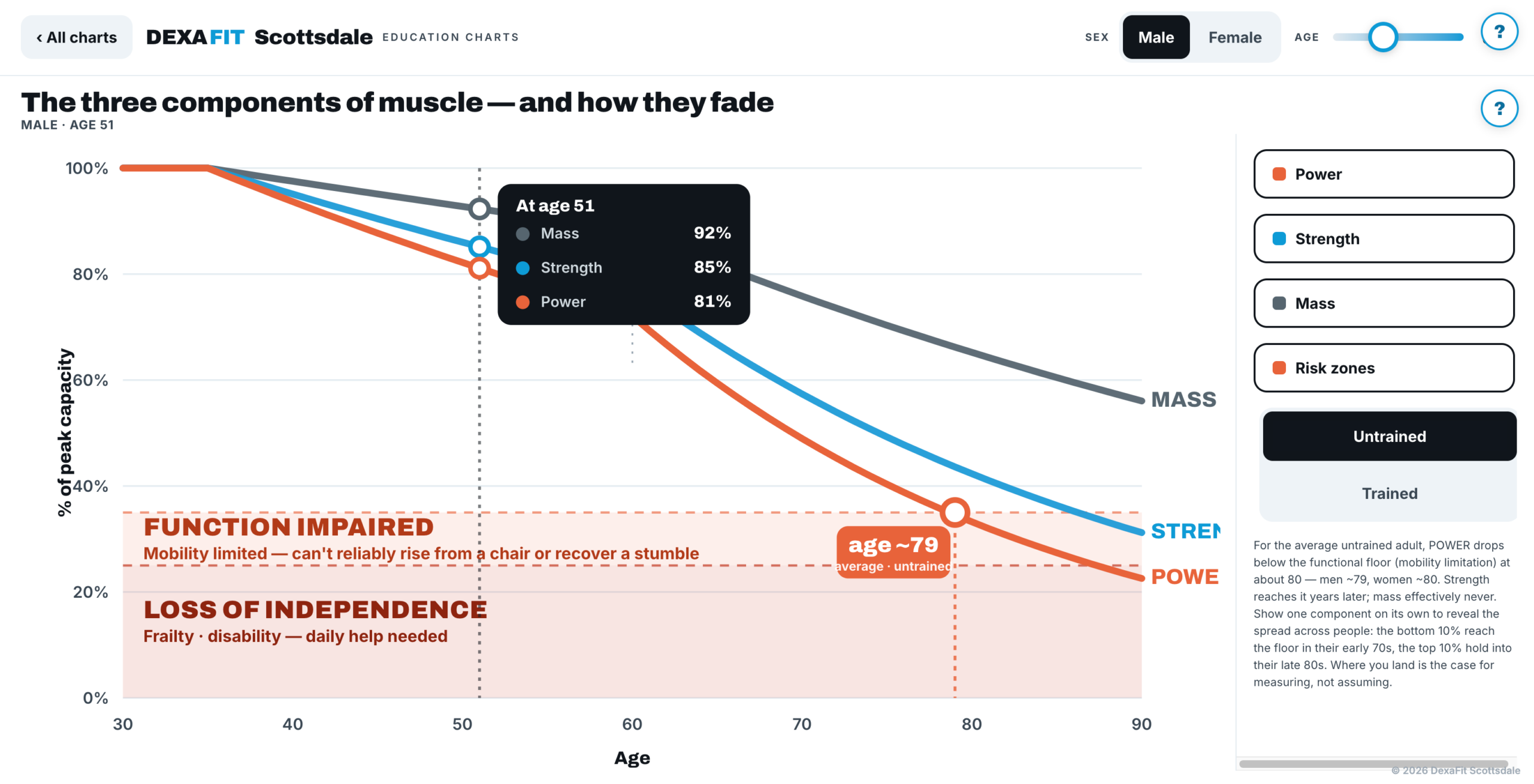
Muscle is often thought of as a single thing, but it is actually made up of three distinct components: mass, strength, and power. While all three naturally decline with age, they do not disappear at the same rate—and understanding the difference can help you stay healthier, stronger, and independent for longer.
The chart above is a representation of how these components typically change over time. Individual results vary based on genetics, lifestyle, nutrition, and exercise habits.
Muscle Mass: The Slowest to Decline
Muscle mass is the amount of muscle tissue your body has. It provides the foundation for movement, metabolism, and physical performance.
Although muscle mass gradually decreases with age, it tends to decline more slowly than the other two components. This is why many people can still appear muscular while noticing that everyday activities are becoming more difficult.
Maintaining muscle mass requires:
- Regular resistance training
- Adequate protein intake
- Consistent physical activity
- Sufficient recovery and sleep
While preserving muscle mass is important, it doesn’t tell the whole story.
Muscle Strength: The Ability to Produce Force
Strength is your ability to generate force. It’s what allows you to lift groceries, push open heavy doors, climb stairs, or get up from a chair.
Strength generally begins to decline earlier and more rapidly than muscle mass. This means someone may not have lost much muscle size but can still notice they are weaker than they were years earlier.
Fortunately, strength responds extremely well to progressive resistance training—even into your 70s and 80s.
Muscle Power: The First to Fade
Power is often overlooked, but it may be the most important component for maintaining independence.
Power is the ability to produce force quickly. It allows you to:
- Catch yourself if you trip
- Step over an obstacle
- React to a loss of balance
- Climb stairs efficiently
- Rise quickly from a chair
Research consistently shows that muscle power declines faster than either muscle mass or strength. This early loss can affect balance, mobility, reaction time, and the ability to prevent falls.
For many older adults, reduced power—not reduced muscle size—is what first limits daily function.
Why This Matters
Aging doesn’t automatically mean losing independence.
The goal isn’t simply to keep as much muscle as possible—it’s to preserve all three components of muscle function.
Healthy habits that help slow muscle decline include:
- Strength training at least two to three times per week
- Including exercises performed with speed and control when appropriate
- Consuming enough high-quality protein
- Staying physically active throughout the day
- Prioritizing sleep and recovery
These habits support muscle health throughout life and can significantly improve mobility, balance, and quality of life.
Explore More Educational Charts
Understanding muscle health is easier when you can visualize it. The chart shown in this article is part of a growing library of educational resources covering body composition, metabolism, aging, fitness, and longevity.
Visit KingBear Education Charts to explore dozens of interactive charts designed to simplify complex health and performance topics for patients, coaches, clinicians, and anyone interested in living healthier.
New charts are added regularly to help make the science behind health, fitness, and longevity easier to understand.
References
- Cruz-Jentoft AJ, et al. Sarcopenia: Revised European consensus on definition and diagnosis. Age and Ageing. 2019.
- Reid KF, Fielding RA. Skeletal muscle power: A critical determinant of physical functioning in older adults. Exercise and Sport Sciences Reviews. 2012.
- Frontera WR, Ochala J. Skeletal Muscle: A Brief Review of Structure and Function. Calcified Tissue International. 2015.
- American College of Sports Medicine. ACSM Position Stand: Exercise and Physical Activity for Older Adults.