
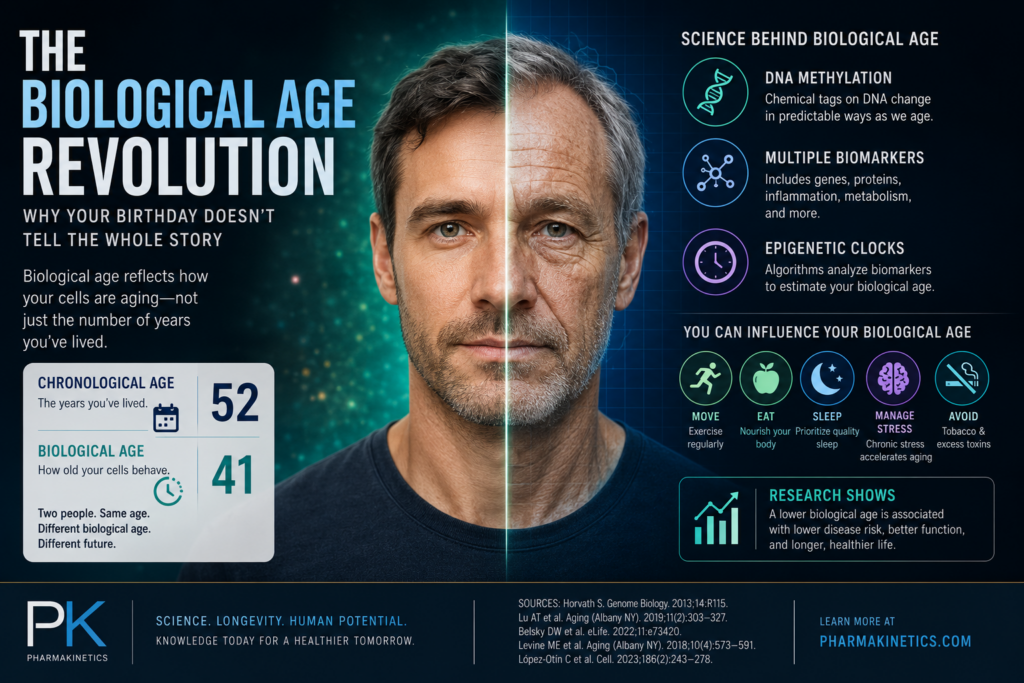
‘‘I’m 52 years old… but am I really 52”
For most of our lives, age has been simple. Every birthday adds another year, and that number becomes our age.
But what if that number doesn’t tell the whole story?
Modern scientists are increasingly looking beyond chronological age—the number of years you’ve been alive—and focusing instead on biological age, a measure of how healthy and resilient your body actually is. Two people born on the same day can have dramatically different biological ages, depending on genetics, lifestyle, environment, and disease.
This shift has sparked what many researchers call the biological age revolution, changing how we think about aging and opening new possibilities for predicting health and longevity.
Chronological Age vs. Biological Age
Chronological age is fixed. It simply counts the years since you were born.
Biological age attempts to answer a different question:
How old do your cells behave?
Researchers have found that the body doesn’t age at the same rate in every person. Some individuals maintain healthy tissues, strong cardiovascular systems, and efficient cellular repair well into later life, while others experience accelerated aging decades earlier.
Because of this, biological age may provide a better picture of future health than birthdays alone.
How Do Scientists Measure Biological Age?
Unlike a blood pressure reading or cholesterol test, biological age isn’t measured with a single number.
Instead, scientists combine information from many biological markers, including:
- DNA methylation patterns
- Gene activity
- Inflammatory markers
- Blood chemistry
- Immune system function
- Organ health
- Physical performance
Among these, DNA methylation has become one of the most studied indicators.
DNA Methylation: Your Cells Leave Time Stamps
Every cell in your body contains essentially the same DNA, but not every gene is active all the time.
Small chemical tags called methyl groups attach to DNA and help regulate which genes are turned on or off. As we age, these methylation patterns change in remarkably predictable ways.
Scientists discovered that by analyzing thousands of these methylation sites across the genome, they could estimate a person’s biological age with surprising accuracy.
These measurements are often called epigenetic clocks.
What Are Epigenetic Clocks?
One of the first major breakthroughs came in 2013 when Dr. Steve Horvath developed what became known as the Horvath Clock, an algorithm capable of estimating biological age using DNA methylation data from multiple tissues.
Since then, researchers have developed newer generations of clocks, including:
- Horvath Clock
- Hannum Clock
- PhenoAge
- GrimAge
- DunedinPACE
Each attempts to predict different aspects of aging, such as lifespan, disease risk, or the rate at which the body is aging.
Rather than simply counting years, these clocks estimate how quickly biological systems are changing over time.
Why Does Biological Age Matter?
A growing body of research suggests that accelerated biological aging is associated with an increased risk of:
- Cardiovascular disease
- Type 2 diabetes
- Cognitive decline
- Frailty
- Certain cancers
- Earlier mortality
Conversely, individuals with a younger biological age often demonstrate better metabolic health, stronger physical function, and lower rates of chronic disease.
Scientists continue to investigate whether slowing biological aging can reduce these risks.
Can You Change Your Biological Age?
This is one of the most exciting—and carefully studied—questions in longevity science.
Research suggests that biological age may be influenced by several lifestyle factors, including:
- Regular physical activity
- Quality sleep
- Balanced nutrition
- Maintaining a healthy weight
- Stress management
- Avoiding tobacco use
- Managing chronic conditions
Several small studies have reported improvements in biological age measurements following lifestyle interventions, although larger and longer-term clinical trials are still needed to determine whether these changes translate into longer or healthier lives.
Researchers are also exploring experimental therapies aimed at slowing or even partially reversing aspects of biological aging, but these approaches remain under active investigation.
The Future of Aging Research
The goal of biological age testing isn’t simply to predict lifespan.
Instead, researchers hope these measurements can identify health risks earlier, evaluate the effectiveness of interventions, and personalize preventive medicine.
As biological age testing becomes more refined, it may eventually become as common as monitoring blood pressure or cholesterol.
While no test can predict the future with certainty, biological age offers a powerful new way to understand how our bodies change over time—and perhaps how we can influence that process.
Key Takeaways
- Chronological age measures how long you’ve lived; biological age estimates how your body is aging.
- DNA methylation patterns are among the strongest current biomarkers of biological aging.
- Epigenetic clocks such as Horvath Clock, GrimAge, and DunedinPACE help estimate biological age using molecular data.
- Biological age may better predict health outcomes than chronological age alone.
- Lifestyle choices appear to influence biological aging, but researchers are still studying how much these changes affect long-term health and lifespan.
References
- Horvath S. DNA methylation age of human tissues and cell types. Genome Biology. 2013;14:R115.
- Lu AT, Quach A, Wilson JG, et al. DNA methylation GrimAge strongly predicts lifespan and healthspan. Aging (Albany NY). 2019;11(2):303–327.
- Belsky DW, Caspi A, Corcoran DL, et al. DunedinPACE, a DNA methylation biomarker of the pace of aging. eLife. 2022;11:e73420.
- Levine ME, Lu AT, Quach A, et al. An epigenetic biomarker of aging for lifespan and healthspan. Aging (Albany NY). 2018;10(4):573–591.
- López-Otín C, Blasco MA, Partridge L, Serrano M, Kroemer G. The Hallmarks of Aging. Cell. 2013;153(6):1194–1217.
- López-Otín C, Blasco MA, Partridge L, Serrano M, Kroemer G. Hallmarks of Aging: An Expanding Universe. Cell. 2023;186(2):243–278.
- National Institute on Aging. Biology of Aging.