
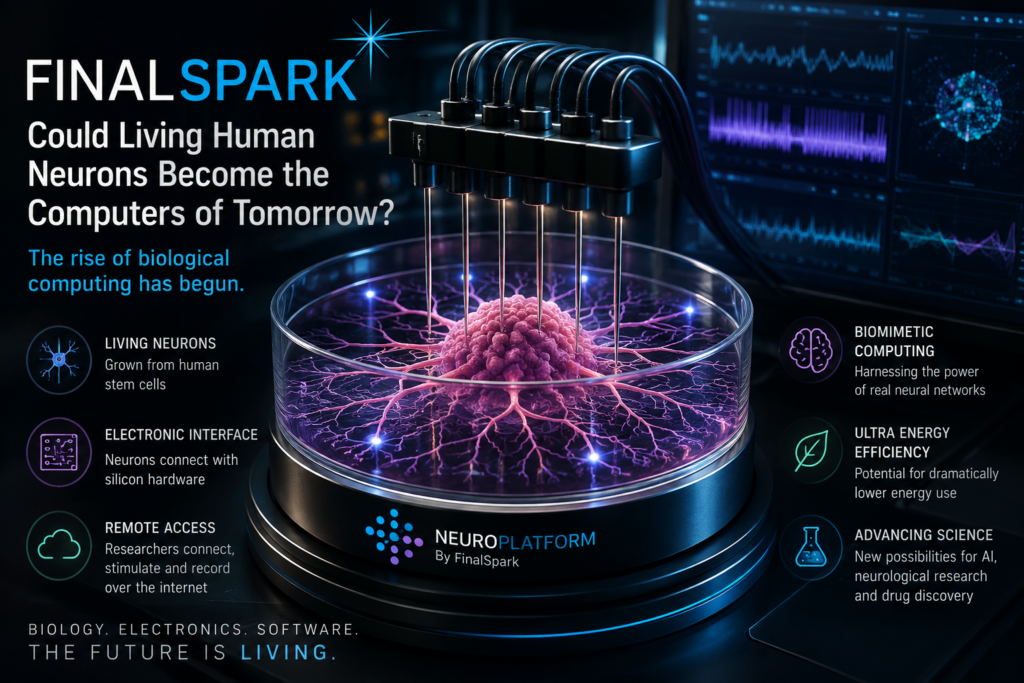
For decades, faster computing has meant building smaller and more powerful silicon chips. But what if the next leap in computing doesn’t come from silicon at all?
A Swiss company called FinalSpark is exploring a radically different idea: using living human neurons as the foundation for a new type of computer. Their work sits at the intersection of neuroscience, artificial intelligence, and bioengineering, and it has sparked both excitement and ethical debate across the scientific community.
What Is FinalSpark?
FinalSpark is a biotechnology company based in Switzerland developing what it calls a Neuroplatform—a remotely accessible research system built around laboratory-grown human brain organoids connected to electronic hardware. Researchers can interact with these living neural networks through software, sending electrical stimulation and recording the neurons’ responses over the internet.
Unlike conventional computers that rely entirely on transistors, FinalSpark’s platform combines biology and electronics in what researchers often call wetware computing.
What Are Brain Organoids?
Brain organoids are tiny three-dimensional clusters of human brain cells grown from stem cells in the laboratory. Although they resemble certain aspects of early brain development, they are not miniature human brains, and they do not possess consciousness or awareness as understood by current science.
Scientists use organoids to study brain development, neurological disease, drug discovery, and increasingly, new approaches to computing.
Why Use Living Neurons?
The human brain remains one of the most energy-efficient computing systems known.
While modern AI systems often require enormous data centers consuming megawatts of electricity, biological neurons perform incredibly complex computations using only tiny amounts of energy.
FinalSpark believes that future biological processors could dramatically reduce the energy required for certain computational tasks, potentially making AI systems far more efficient. The company has highlighted the possibility of energy consumption orders of magnitude lower than traditional silicon processors, although this remains an area of active research.
How Does the Neuroplatform Work?
The Neuroplatform houses living neural organoids on multi-electrode arrays inside carefully controlled incubators. Researchers access the system remotely through Python-based software, allowing them to:
- Record electrical activity from living neurons
- Deliver controlled electrical stimulation
- Analyze neural responses over time
- Run experiments without maintaining their own laboratory
The platform operates continuously, generating large datasets that researchers can use to investigate how biological neural networks process information and adapt to stimulation.
Is This a Biological Computer?
Not yet.
Although media reports sometimes describe these systems as “living computers,” today’s organoid platforms are experimental research tools, not replacements for CPUs or GPUs.
Current systems cannot run operating systems, browse the internet, or replace conventional processors. Instead, researchers are studying fundamental questions such as whether living neurons can learn patterns, adapt to repeated inputs, and perform specific computational tasks that are difficult for traditional hardware.
Ethical Questions
As biocomputing advances, so do ethical discussions.
Researchers continue to examine questions including:
- How should living neural tissue be used responsibly?
- Could increasingly complex organoids require new ethical guidelines?
- Where should the boundary be drawn between biological research and computing technology?
Most scientists agree that current brain organoids lack the complexity required for consciousness, but many also believe ethical oversight should evolve alongside the technology.
Key Takeaways
- FinalSpark is developing one of the world’s first remotely accessible biocomputing research platforms.
- The Neuroplatform uses laboratory-grown human brain organoids connected to electronic hardware.
- Researchers can remotely stimulate and monitor living neurons using software.
- The goal is to explore ultra-energy-efficient forms of computation inspired by biology.
- Biocomputing remains experimental, but it is one of the most intriguing frontiers in neuroscience and artificial intelligence.
References
- FinalSpark. Neuroplatform.
- FinalSpark. Biological Neuroplatform Up and Running.
- FinalSpark. Neuroplatform Poster.
- Business Wire. FinalSpark Launches the First Remote Research Platform Using Human Neurons for Biocomputing.