
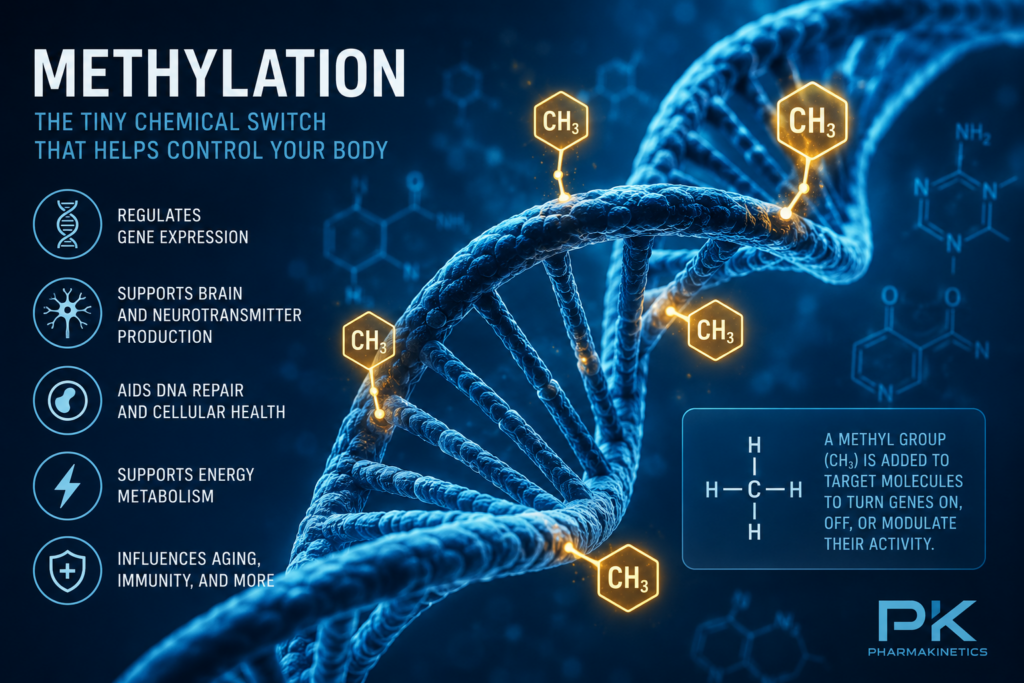
Methylation is one of the most important biological processes you’ve probably never heard of. Every second, billions of methylation reactions occur throughout your body, helping regulate how your cells function, how your genes are expressed, how your brain works, and how efficiently you produce energy. While your DNA provides the blueprint for life, methylation helps determine how that blueprint is used.
What Is Methylation?
Methylation is the process of attaching a small chemical group—called a methyl group (CH₃)—to another molecule. Although tiny, this chemical tag can dramatically change how molecules behave. Rather than altering your DNA, methylation acts like a switch that helps turn certain biological processes on, off, or somewhere in between.
Methylation plays a role in:
- Regulating gene activity
- Repairing DNA
- Producing neurotransmitters
- Supporting energy metabolism
- Building healthy cell membranes
- Controlling inflammation
- Supporting normal cardiovascular function
Methylation and Your DNA
One of methylation’s most important jobs is regulating gene activity through a process known as DNA methylation. Every cell in your body contains essentially the same DNA, yet liver cells, muscle cells, and brain cells all perform different functions. Methylation helps determine which genes are active in each cell without changing the DNA sequence itself.
This is part of epigenetics—the study of how chemical changes influence gene expression without altering your genetic code.
Why Methylation Matters
Researchers have found that methylation patterns naturally change as we age. These changes may influence how cells function over time and are one reason scientists use DNA methylation when studying biological aging through epigenetic clocks.
Methylation is also essential for producing neurotransmitters such as dopamine and serotonin, supporting DNA repair, and helping cells divide and replace themselves throughout the body.
Nutrition and Methylation
Healthy methylation depends on several vitamins and nutrients that work together in what scientists call the one-carbon metabolism pathway. Important nutrients include:
- Folate (Vitamin B9)
- Vitamin B12
- Vitamin B6
- Riboflavin (Vitamin B2)
- Choline
- Betaine
- Methionine
A balanced diet typically provides these nutrients, although individual requirements can vary.
Genetics and Lifestyle
Genes also influence methylation. One of the best-known examples is the MTHFR gene, which helps process folate. Certain genetic variants may affect methylation efficiency, but having an MTHFR variant does not necessarily indicate poor health or require treatment.
Lifestyle factors such as nutrition, exercise, sleep, smoking, alcohol use, stress, and environmental exposures can also influence methylation over time, making it a dynamic process rather than a fixed characteristic.
Why Scientists Study Methylation
Because methylation affects so many biological systems, it has become a major focus of research in:
- Healthy aging
- Cognitive function
- Cardiovascular health
- Cancer biology
- Immune regulation
- Metabolic health
- Precision medicine
As researchers continue to learn more, methylation is helping improve our understanding of how genetics, nutrition, and lifestyle work together to influence long-term health.
Key Takeaways
- Methylation is a natural process that adds small chemical tags to molecules throughout the body.
- It helps regulate gene activity without changing your DNA.
- Methylation supports DNA repair, brain function, energy production, and healthy cell growth.
- DNA methylation patterns change with age and are widely studied as biomarkers of biological aging.
- Nutrition, genetics, and lifestyle all contribute to healthy methylation.
References
- Moore LD, Le T, Fan G. DNA Methylation and Its Basic Function. Neuropsychopharmacology. 2013.
- Jones PA. Functions of DNA Methylation. Nature Reviews Genetics. 2012.
- Horvath S. DNA Methylation Age of Human Tissues and Cell Types. Genome Biology. 2013.
- Field MS, Stover PJ. One-Carbon Metabolism and Nutritional Epigenetics. Annual Review of Nutrition. 2018.
- National Institutes of Health Office of Dietary Supplements. Folate Fact Sheet.
- National Institutes of Health Office of Dietary Supplements. Vitamin B12 Fact Sheet.